THIS WEEK'S READ: "BLACK BOX THINKING - why most people never learn from their mistakes - but some do" by M. Syed

September 27th, 2026

Blurb quote: "Nobody wants to fail. But in highly complex organizations, success can happen only when we confront our mistakes, learn from our own version of a black box, and create a climate where it’s safe to fail.
We all have to endure failure from time to time, whether it’s underperforming at a job interview, flunking an exam, or losing a pickup basketball game. But for people working in safety-critical industries, getting it wrong can have deadly consequences. Consider the shocking fact that preventable medical error is the third-biggest killer in the United States, causing more than 400,000 deaths every year. More people die from mistakes made by doctors and hospitals than from traffic accidents. And most of those mistakes are never made public, because of malpractice settlements with nondisclosure clauses.
For a dramatically different approach to failure, look at aviation. Every passenger aircraft in the world is equipped with an almost indestructible black box. Whenever there’s any sort of mishap, major or minor, the box is opened, the data is analyzed, and experts figure out exactly what went wrong. Then the facts are published and procedures are changed, so that the same mistakes won’t happen again. By applying this method in recent decades, the industry has created an astonishingly good safety record.
Few of us put lives at risk in our daily work as surgeons and pilots do, but we all have a strong interest in avoiding predictable and preventable errors. So why don’t we all embrace the aviation approach to failure rather than the health-care approach? As Matthew Syed shows in this eye-opening book, the answer is rooted in human psychology and organizational culture.
Syed argues that the most important determinant of success in any field is an acknowledgment of failure and a willingness to engage with it. Yet most of us are stuck in a relationship with failure that impedes progress, halts innovation, and damages our careers and personal lives. We rarely acknowledge or learn from failure—even though we often claim the opposite. We think we have 20/20 hindsight, but our vision is usually fuzzy.
Syed draws on a wide range of sources—from anthropology and psychology to history and complexity theory—to explore the subtle but predictable patterns of human error and our defensive responses to error. He also shares fascinating stories of individuals and organizations that have successfully embraced a black box approach to improvement, such as David Beckham, the Mercedes F1 team, and Dropbox."
Reading is one of favourite things to do, but I try to create a balance between a book that teaches me something and a book that is read simply for the pleasure of reading.
This week's read from one of my favourite Canadian authors: The King's Messenger.
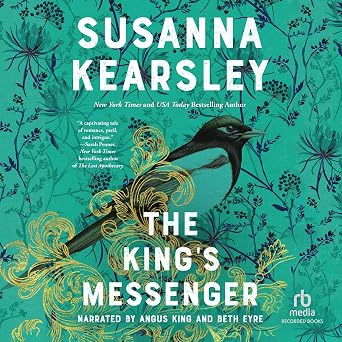
Blurb quote: New York Times, USA Today and international bestselling author Susanna Kearsley explores romance, court alliances, and the limits of one's duty in this rich story of an honorable man in service to a treacherous king, and the mission that brings him to love and his true calling.
It is the year 1613, and King James is sending his messenger Andrew Logan into Scotland with secret orders to arrest Sir David Moray, close friend and advisor of the late Prince Henry. Secrets are second nature to Andrew, who must hide his Second Sight to stay alive. Joined by a court scrivener and the scrivener's spirited daughter Phoebe, Andrew slowly untangles the true purpose of his mission—to frame Sir David for Prince Henry's murder. But Andrew is unwilling to betray an innocent man.
Phoebe Westaway dislikes Andrew, and their history makes it hard for her to trust him. But as their journey draws them deeper into the dark web of court intrigue, Phoebe begins to suspect that she might have more need of the King's Messenger and his unusual gifts than she could ever have foreseen.
Happy Reading Everyone!


Comments